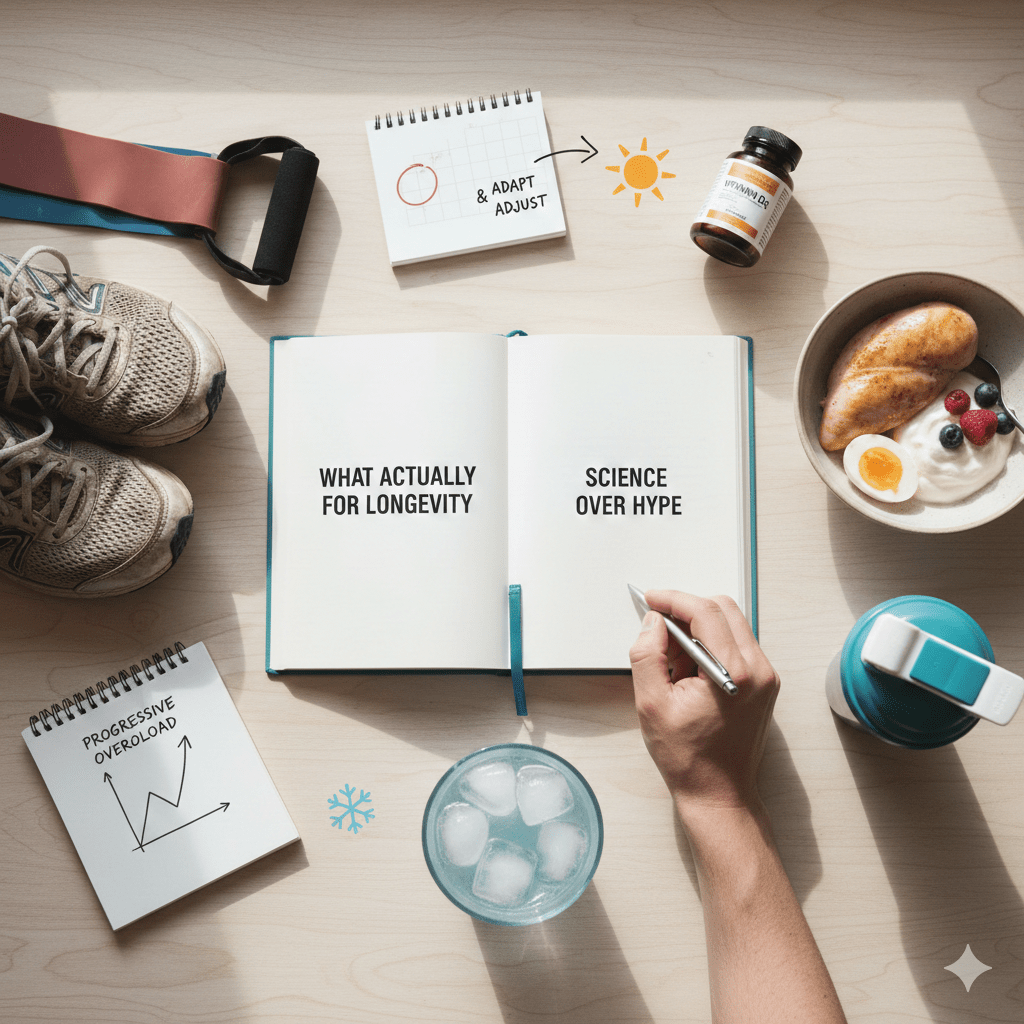
READING_TIME: 12 minutes
—
The longevity space is drowning in noise. 📢
Every week brings a new supplement, a flashy biohack, or a miracle protocol promising to add years to your life. But when you cut through the marketing and ask the people closest to aging science what actually works, a surprisingly clear picture emerges.
The most effective longevity strategies aren’t exotic or expensive. They’re built on understanding how your body adapts, what it needs to thrive, and how to design habits that work with your biology instead of against it.
Let’s break down what the research—and the experts—actually say works.
WHY YOUR WORKOUT STOPPED WORKING (AND HOW TO FIX IT)
If you’ve been doing the same workout routine for months and wondering why your progress stalled, there’s a simple explanation: your body has adapted. Muscles are remarkably efficient, and when nothing changes for too long, they stop growing stronger.
This isn’t a sign you need to train harder—it’s a sign you need to train smarter. 💪
The principle behind continuous improvement is called progressive overload, and it’s one of the most well-established concepts in exercise science. But here’s what most people get wrong: progressive overload doesn’t mean constantly adding more weight to the bar.
Smart Ways to Progress Your Training
Progress can come from multiple directions:
→ More total volume: Adding an extra set to your workout
→ Better movement quality: Slowing down the eccentric (lowering) phase of an exercise
→ Increased time under tension: Pausing at the bottom of a squat
→ Improved range of motion: Going deeper into movements as mobility improves
→ Higher frequency: Training a muscle group one more time per week
The beauty of this approach is that it protects your joints while still challenging your muscles. You don’t need to chase heavier weights forever—you can build meaningful strength through smarter progression strategies that your body can sustain for decades.
For longevity, this matters enormously. The goal isn’t just to be strong today; it’s to maintain strength and function well into your 70s, 80s, and beyond. Progressive overload done intelligently is how you get there.
THE PROTEIN QUESTION: HOW MUCH DO YOU ACTUALLY NEED?
For years, protein was dismissed as “gym bro” territory—something only bodybuilders needed to worry about. That narrative has collapsed under the weight of evidence showing that adequate protein intake is essential for maintaining muscle mass, metabolic health, and functional independence as we age.
The current scientific consensus points to 30 to 35 grams of protein per meal, distributed throughout the day, as optimal for muscle protein synthesis. 🥩
Why Protein Timing Matters
Your body doesn’t store amino acids the way it stores fat or carbohydrates. When you eat protein, your body uses what it needs for immediate repair and maintenance, then the rest gets metabolized. This is why spreading protein intake across meals works better than loading it all into one sitting.
Research shows that muscle protein synthesis—the process of building and repairing muscle tissue—peaks when you consume adequate protein at regular intervals. For most people, this means hitting that 30-35g target at breakfast, lunch, and dinner.
What Does 30 Grams of Protein Look Like?
To put this in practical terms:
→ 4 ounces of chicken breast: approximately 35g protein
→ 5 large eggs: approximately 30g protein
→ 1 cup Greek yogurt: approximately 20g protein (add nuts or seeds to reach 30g)
→ 4 ounces salmon: approximately 28g protein
→ 1 cup cottage cheese: approximately 28g protein
→ 1 scoop quality whey protein plus milk: approximately 30g protein
This isn’t about turning every meal into a macro-counting exercise. It’s about building plates that actually support your body’s needs, especially as you age and muscle maintenance becomes more challenging.
COLD EXPOSURE: WHAT THE SCIENCE ACTUALLY SHOWS
Cold plunges have become a longevity trend, complete with influencer endorsements and dramatic ice bath videos. But beneath the spectacle, there’s legitimate science worth understanding. ❄️
Recent research followed participants through one week of cold exposure and found something fascinating: while the initial response was stress (as expected), the body adapted quickly. Within days, inflammation markers decreased, cellular repair mechanisms activated, and immune function improved.
The Autophagy Connection
The key mechanism appears to be autophagy—your body’s cellular housekeeping system. When cells experience controlled stress (like cold exposure), they activate cleanup protocols that remove damaged components and recycle them into new, functional parts.
By the end of the study week, participants:
→ Shivered less during exposure
→ Adapted more efficiently to temperature changes
→ Showed enhanced immune cell responsiveness
→ Demonstrated markers of improved cellular repair
The Right Way to Approach Cold Exposure
This doesn’t mean you should jump into an ice bath tomorrow. The benefits come from gradual, consistent exposure that allows your body to adapt without overwhelming it.
Start with:
→ Ending showers with 30-60 seconds of cold water
→ Gradually extending duration as you adapt
→ Focusing on controlled breathing during exposure
→ Consistency over intensity—regular mild exposure beats sporadic extreme sessions
The goal is hormetic stress: enough challenge to trigger adaptation, but not so much that it causes harm or becomes unsustainable.
THE SCIENCE OF GOALS THAT ACTUALLY LAST
January is peak goal-setting season, yet most New Year’s resolutions fail by February. The problem isn’t willpower—it’s how we’re taught to set goals in the first place. 🎯
A comprehensive meta-analysis of goal-setting research revealed something counterintuitive: outcome-driven goals (the kind we’re culturally encouraged to set) are actually the least effective. Some even erode confidence over time when they’re not met.
What Works: Self-Regulation Over Rigid Targets
The goals that succeed aren’t more specific or more rigid—they’re built differently. They prioritize self-regulation: the ability to monitor your progress, adjust your approach as conditions change, and stay responsive rather than rigidly attached to a predetermined outcome.
This means:
Instead of: “I will lose 20 pounds by March”
Try: “I will build habits that support my energy and health, tracking how I feel and adjusting as I learn what works for my body”
Instead of: “I will work out 5 days per week no matter what”
Try: “I will move my body regularly in ways that feel sustainable, adding structure as my capacity grows”
The difference is subtle but profound. Rigid outcome goals set you up for an all-or-nothing mindset where any deviation feels like failure. Self-regulation goals create space for learning, adaptation, and sustainable progress.
Working With Your Nervous System
The people who succeed long-term are better at listening to their bodies and adjusting course. They treat setbacks as information rather than failure. They build feedback loops that help them stay connected to their goals without being controlled by them.
This approach works with your nervous system instead of against it, reducing the stress response that often accompanies rigid goal-setting and making it easier to maintain momentum over months and years.
VITAMIN D AND CELLULAR AGING: WHAT WE KNOW
Vitamin D has long been recognized for its role in bone health and immune function, but newer research is examining its relationship to cellular aging—specifically, its potential impact on telomeres. ☀️
Telomeres are protective caps on the ends of chromosomes that shorten as we age. Shorter telomeres are associated with increased disease risk and reduced longevity. The question researchers are exploring: does vitamin D influence telomere length?
The Current Evidence
Several studies have found correlations between higher vitamin D levels and longer telomeres. However, correlation doesn’t equal causation, and the mechanisms aren’t fully understood yet.
What we do know:
→ Vitamin D plays a role in reducing inflammation, which is linked to telomere shortening
→ Adequate vitamin D levels support immune function and cellular health
→ Deficiency is widespread, particularly in northern latitudes and among people who spend most time indoors
→ Supplementation is relatively safe and inexpensive when done appropriately
Getting Your Vitamin D Right
The challenge with vitamin D is that it’s difficult to get enough from food alone, and sun exposure varies dramatically based on geography, season, and lifestyle.
Testing your levels is the smartest first step. Most experts recommend maintaining blood levels between 30-50 ng/mL, though optimal ranges are still debated.
For supplementation:
→ Most adults benefit from 1,000-2,000 IU daily, though some may need more
→ Vitamin D3 (cholecalciferol) is generally preferred over D2
→ Taking it with fat-containing meals improves absorption
→ Regular testing helps you dial in the right dose for your body
While the telomere research is still evolving, maintaining adequate vitamin D levels has enough other proven benefits that it’s worth attention regardless.
THE TAKEAWAY: SIMPLICITY WINS
When you strip away the marketing and examine what aging researchers actually prioritize, the picture is remarkably straightforward.
The most effective longevity strategies are:
✓ Training intelligently with progressive overload that you can sustain for decades
✓ Eating adequate protein distributed throughout the day to maintain muscle mass
✓ Using controlled stressors like cold exposure to trigger beneficial adaptations
✓ Setting goals that emphasize self-regulation over rigid outcomes
✓ Maintaining adequate vitamin D levels for cellular health
None of these require expensive supplements, exotic protocols, or dramatic lifestyle overhauls. They require understanding how your body works and building habits that support it consistently over time.
The longevity game isn’t won with shortcuts or biohacks. It’s won with sustainable practices that compound over years and decades—practices your body can not only tolerate but thrive on.
CONCLUSION
Real longevity isn’t found in the latest supplement or trending biohack. The evidence points to something far more accessible: understanding your body’s fundamental needs and meeting them consistently. Smart training progression protects your joints while building lasting strength. Adequate protein supports the muscle mass that keeps you functional into your later decades. Controlled stressors like cold exposure trigger cellular repair mechanisms. Flexible, self-regulating goals work with your nervous system instead of against it. And maintaining vitamin D levels supports cellular health in ways we’re only beginning to understand. These aren’t revolutionary discoveries—they’re evidence-based fundamentals that work because they align with how your biology actually functions.
CTA: Which of these evidence-based strategies will you implement first? Share your experience in the comments below, and subscribe to stay updated on the latest longevity science that actually matters—no hype, just research-backed insights you can use.
This blog is compiled from 16 sources.
Please note: Me, AI and underlying material can make mistakes.

Leave a comment